Showing posts with label Cerro Tronador. Show all posts

June 21, 2012

South America - Argentina Nahuel Huapi, Why is it Black not Blue?

We went to Hosteria Pampa Linda for lunch.  It is a gorgeous place. I and Sarah had a table next to the window, with an open view to the Cerro Tronador.
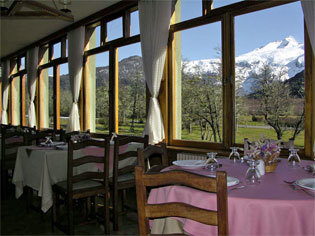
From http://www.hosteriapampalinda.com.ar/english/servicios-pampa-linda.html#restaurante
The lunch was authentic pumpkin soup, my favourite. I felt much better after a home-make lunch, and recovered from the fatigue and all the restless days.  Sarah was staying here for a couple of days to hike around.  The guide came here to drop her, and the rest of us continued the afternoon to see the relic Black Glacier.  The Black Glacier name is Ventisquero Negro.
Ventisquero Negro, Nahuel Huapi National Park
Argentina, Apr 2010.
Feeding by the ice from the summit of Cerro Tronador, the Black Glacier becomes a huge mass of ice dragging every sediment and mineral along the way sliding down the peak, making it one of the biggest icer tounges around.  The process of melting and freezing is making its composition possible through crystallization of mineral and ice.
Ventisquero Negro, Nahuel Huapi National Park
Argentina, Apr 2010.
Ventisquero Negro, Nahuel Huapi National Park
Argentina, Apr 2010.
The layers in the ice represents the years of crystallization.  Thus, the age of the icer tounge is told by the line in the ice. Similar to the way we look at the age of a tree, the circular line in the log of a lumber is the age of the tree.  In the case below, a very icer tounge had broken off.
Ventisquero Negro, Nahuel Huapi National Park
Argentina, Apr 2010.
As much as we would not want it to happen, the sign of global warming is clearly seen here.  The glacier becomes smaller when its icer tounge broke off and flowed away.
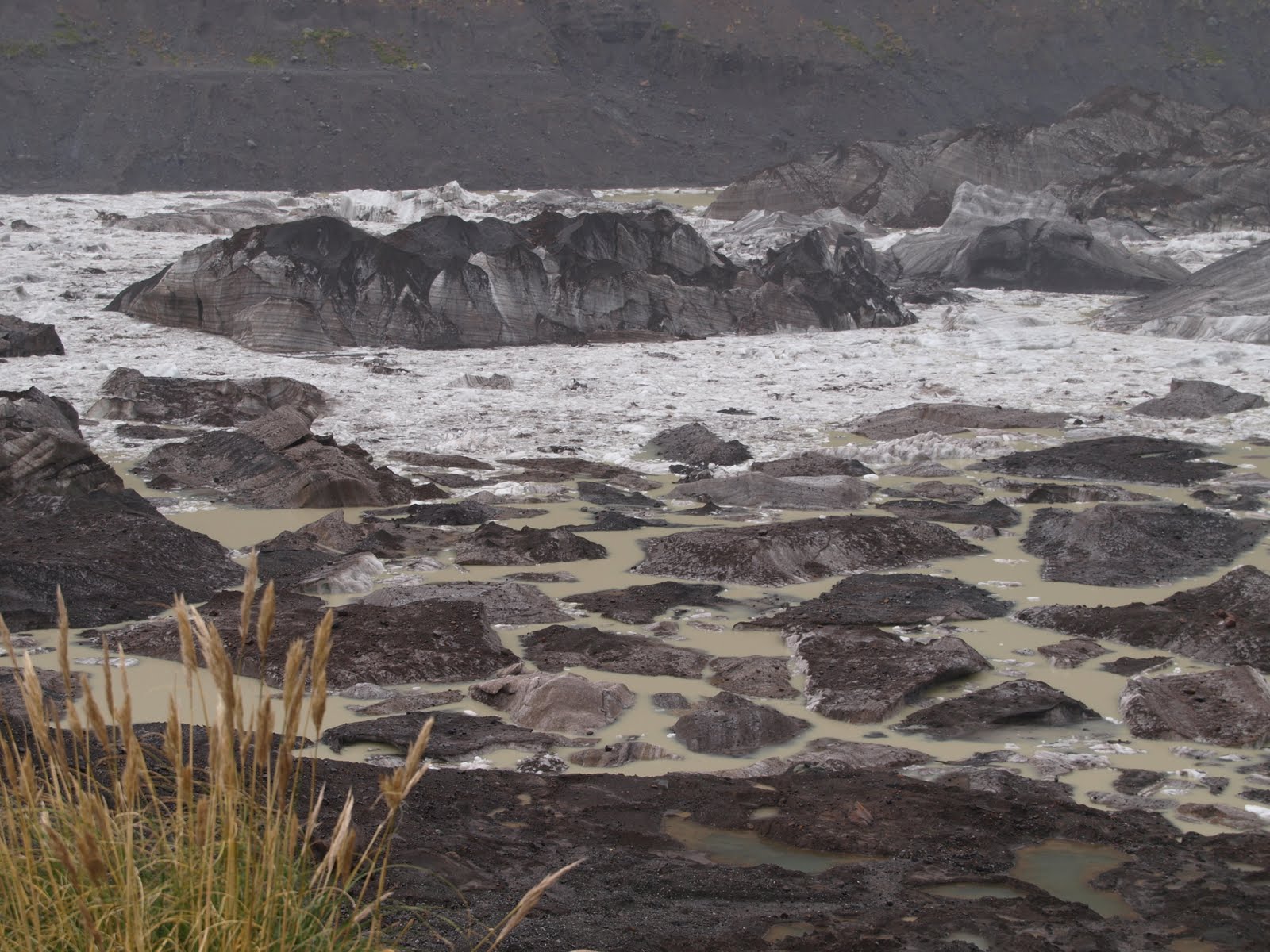
Ventisquero Negro, Nahuel Huapi National Park
Argentina, Apr 2010.
The guide was right! It did take a rainy day without sun to see something as unique as the Black Glacier.

I was tired without word when I was back to the hostal.  Thus, I demanded, for the first time in the journey, to have a room changed and the heater turn on. I slept straight through the night till late morning the next day.

June 17, 2012

South America - Argentina Nahuel Huapi, Journey to the Black Glacier

I spent a week from trekking Glaciar Perito Moreno to Los Torres del Paine, finishing 1st leg of the journey in 3 weeks.  Subsequently, it was all road trips, 5 hours evening bus from Torres del Paine to El Calafate. A tiring night with a next day flight and another ride, then I arrived Bariloche which is called 'Switzerland of Argentina'.

Exhausted with fatigue, I was pretty unlucky the 1st night to have a dorm-mate who snored ever loudest and it was a hostal that seemed to forget to turn on the heater.  It was freezing cold and I hardly slept.  Without proper rest, I was up early at 4am while the trip to the Nahuel Huapi National Park starting at 7am.

Nahuel Huapi National Park is no strange subject to any Argentinean.  The oldest national park in the country, with the national hero Francisco Moreno donated 75 square kilometres (29 sq mi) of land in the area to the federal government in 1903, Nahuel Huapi is nearly 2 Million Acres in size and surrounds Nahuel Huapi Lake.  In the famous Mapuche language, Nahuel Huapi means 'Jaguar Island'.

My guide is a German descendent.  It seems the population around the lake region in both Argentina and Chile are mainly German descendent. Off we went to pick up a full van of Brazilian (Brazilian loves to visit Bariloche till Argentinean deem Bariloche as Braziloche), and another British navy, Sarah.  As we entered the national park, I noticed that the wall of some of the mountain had marks left by glacier movement.
Nahuel Huapi National Park - Argetntina, Apr 2010.
It shows the ice age of the earth. As our van passed one part of the forest, I saw a hollow pathway through the wood.  It seemed like a tunnel which swept by some heavy objects through the forest.
Nahuel Huapi National Park - Argetntina, Apr 2010.
I asked the guide why the national park just swept and made path like that, and the guide said "It was not us, it was the ice!"  Apparently, this happened almost every spring.  After winter, the water in the mountain built up the ice.  When the ice started to melt in spring, it started to move, then down the hill, sweeping everything along with it!  The guide told me as he comes to the park almost every other day, it happened once the ice was moving down hill and passed right in front of his van, making a sound that he will never forget.  Judging from the photo, the force was tremendous!

We arrived the vista point at the Nahuel Huapi Lake, where we saw the snow capped Cerro Tronador from a distant.
Cerro Tronador, Nahuel Huapi National Park
Argetntina, Apr 2010.
The national park is in the Patagonia Andean Zone, the Altoandino which above 1600 meters will be perpetually covered by snow. The Valvidian RainForest here (and in Chile) is one of the rare and unique rainforest existed to the area.

As we furthered into the national park, we came to a vista point to view the Piuque Huapi, Piuque means 'Heart' in Mapuche. The Heart (shaped) Island was the cover of the national park brochure.  But, the vista point is not high enough that I was not able to capture the island in a heart shaped. However, I would have to say it is beautiful! 
Piuque Huapi, Nahuel Huapi National Park
Argetntina, Apr 2010.
The morning passed by without the sun, the grey cloud moved in and the sky started to have cold drizzle. I was quite down due to lack of sleep.  As I blared out that may be my luck had run out with good weather, the guide turned, smiled and said to me "No, you are in luck today!" I was thinking "Ya, right!" Then, he continued "We can only see the Black Glacier clearly after the rain, without the sun reflection!"